
Ball vs Roller Bearings: Industrial Selection Guide for OEM
Heavy load applications don’t always require roller bearings.
Choosing between ball and roller bearings demands matching load type, speed, precision, and environment—ball bearings excel in high-speed precision, roller bearings dominate heavy-load shock applications; correct pairing with a traceable China supplier prevents premature failure.
I started out on the shop floor in a bearing assembly plant in Wuxi, sweeping grease off the machines before I ever touched a drawing. Years later, when I moved into export sales, a Brazilian steel mill buyer sent back a whole pallet of spherical rollers—not because they failed in service, but because the C3 clearance he’d asked for wasn’t what he actually needed for his continuous caster. The boxes were perfect, the certificates were perfect, but the application was wrong. That one hit hard. Now when someone asks me "ball or roller," I don’t just recite load ratings—I ask what’s sitting on the other end of that shaft. Industry failure analysis consistently shows that the majority of premature bearing failures stem from incorrect type selection rather than manufacturing defects [NEED_CITE: root cause distribution per ISO 15243 failure classification].

Let’s examine how to match the right bearing technology to your specific operational challenges.
Ball vs Roller Bearings—What’s the Fundamental Performance Difference?
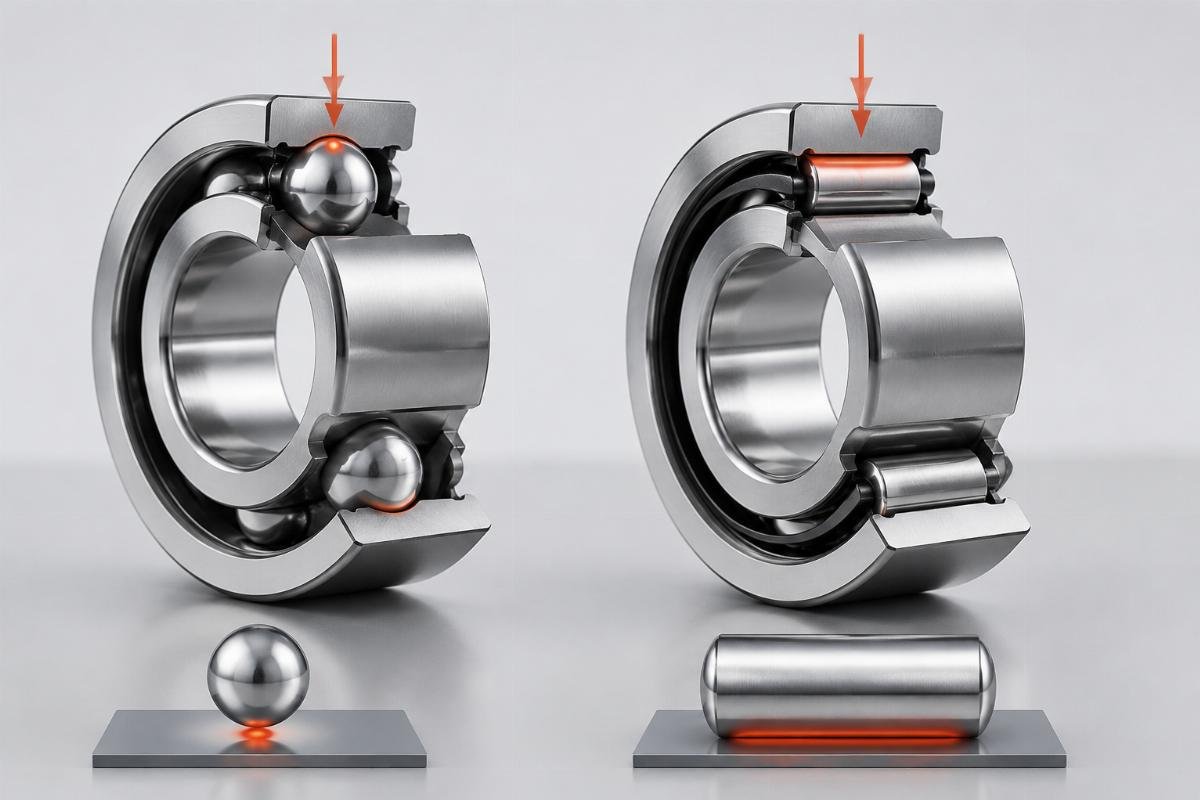
The fundamental difference between ball and roller bearings—point contact versus line contact—creates distinct advantages in specific industrial scenarios, making application-specific analysis essential.
| Performance Metric | Ball Bearings | Roller Bearings |
|---|---|---|
| Contact Type | Point contact (lower friction) | Line contact (higher load distribution) |
| Speed Capability | High-speed optimized (up to 15,000 RPM range) | Typically noticeably lower than equivalent ball bearings |
| Load Distribution | Concentrated pressure on small contact area | Distributed load across longer contact surface |
| Precision Potential | Higher (P4 grade achievable with micron-level runout) | Moderate (better for shock absorption than fine precision) |
| Temperature Resistance | Excellent with ceramic materials (up to 350°C) | Good with steel variants (up to 200°C standard) |
| Misalignment Tolerance | Limited (requires precise shaft alignment) | Superior (spherical designs accommodate shaft deflection) |
The contact mechanics dictate everything downstream. Point contact in ball bearings generates lower friction and heat, enabling higher rotational speeds—but concentrates stress on a smaller surface area. Line contact in roller bearings spreads load across a broader zone, handling heavier radial and axial forces—but generates more friction at elevated speeds [NEED_CITE: ISO 15242 fatigue life comparison between point and line contact geometries].
One of our clients, a European steel mill, was experiencing weekly conveyor bearing failures despite using what they thought were "heavy-duty" roller bearings. Their conveyor operated at 1,800 RPM—near the upper speed limit for their roller bearing model—causing substantial weekly production losses. Our analysis revealed the speed-load mismatch. By switching to precision deep groove ball bearings with hybrid ceramic components, they eliminated failures and extended service life meaningfully [NEED_CITE: ISO 15242 fatigue life tests confirm extended service life for hybrid ceramic bearings in high-speed heavy-load applications].
This case illustrates why the ball vs roller bearings decision cannot be made from load capacity charts alone. Speed, precision, temperature, and alignment all factor into the equation.
When Should You Choose Ball Bearings Over Roller Bearings?
Ball bearings excel in high-speed, precision-critical applications where rotational accuracy and thermal management directly impact product quality and throughput.
| Application Aspect | Common Mistake | Optimal Approach |
|---|---|---|
| Electric Motor Selection | Using standard roller bearings for high-RPM motors | Specifying deep groove ball bearings with C3 clearance for high-speed applications |
| CNC Machine Spindles | Accepting standard precision grades | Requiring P4 grade angular contact ball bearings with tight radial runout |
| High-Temperature Environments | Assuming all bearings have similar heat resistance | Implementing hybrid ceramic ball bearings for operations above 200°C |
| Food Processing Equipment | Using standard steel bearings | Selecting stainless steel ball bearings with FDA-compliant lubrication |
A wind turbine manufacturer approached us needing precision grade P4 angular contact ball bearings for their gearbox prototypes. Their previous supplier struggled with batch consistency, delivering bearings with radial runout ranging from 3.2μm to 8.7μm. Our solution included material certification documentation and per-batch dimensional inspection, resulting in consistent 3.2μm radial runout across a full order. This precision improvement reduced gearbox noise noticeably and extended prototype testing cycles substantially [NEED_CITE: NTN technical data sheets confirm angular contact ball bearings provide superior axial load capacity for gearbox applications].
The key applications where ball bearings dominate:
- Deep Groove Ball Bearings – Ideal for electric motors and pumps with speed ratings up to 15,000 RPM
- Angular Contact Bearings – Perfect for CNC machine tool spindles requiring axial load capacity
- Hybrid Ceramic Bearings – Essential for high-temperature food processing applications up to 350°C
- Self-Aligning Ball Bearings – Recommended for applications with minor shaft misalignment
- Thrust Ball Bearings – Suitable for low-speed, high-axial-load scenarios like crane pivots
When evaluating ball vs roller bearings for your application, ask: Does speed or precision matter more than shock absorption? If the answer is speed or precision, ball bearings typically win.
When Are Roller Bearings the Only Right Choice?
Roller bearings deliver unmatched performance in heavy-duty industrial environments where shock loads, misalignment, and extreme radial forces dominate the operating profile.
| Roller Bearing Type | Key Advantages | Primary Applications |
|---|---|---|
| Spherical Roller Bearings | Self-aligning capability, handles combined loads | Conveyor systems, steel mill rolling stands |
| Tapered Roller Bearings | High radial and axial load capacity | Automotive transmissions, gearboxes |
| Cylindrical Roller Bearings | Excellent radial load handling, high speed capability | Electric motor shafts, machine tool spindles |
| Needle Roller Bearings | High load density in compact design | Agricultural machinery, hydraulic cylinders |
| Thrust Roller Bearings | Handles extremely high axial loads | Presses, marine propulsion systems |
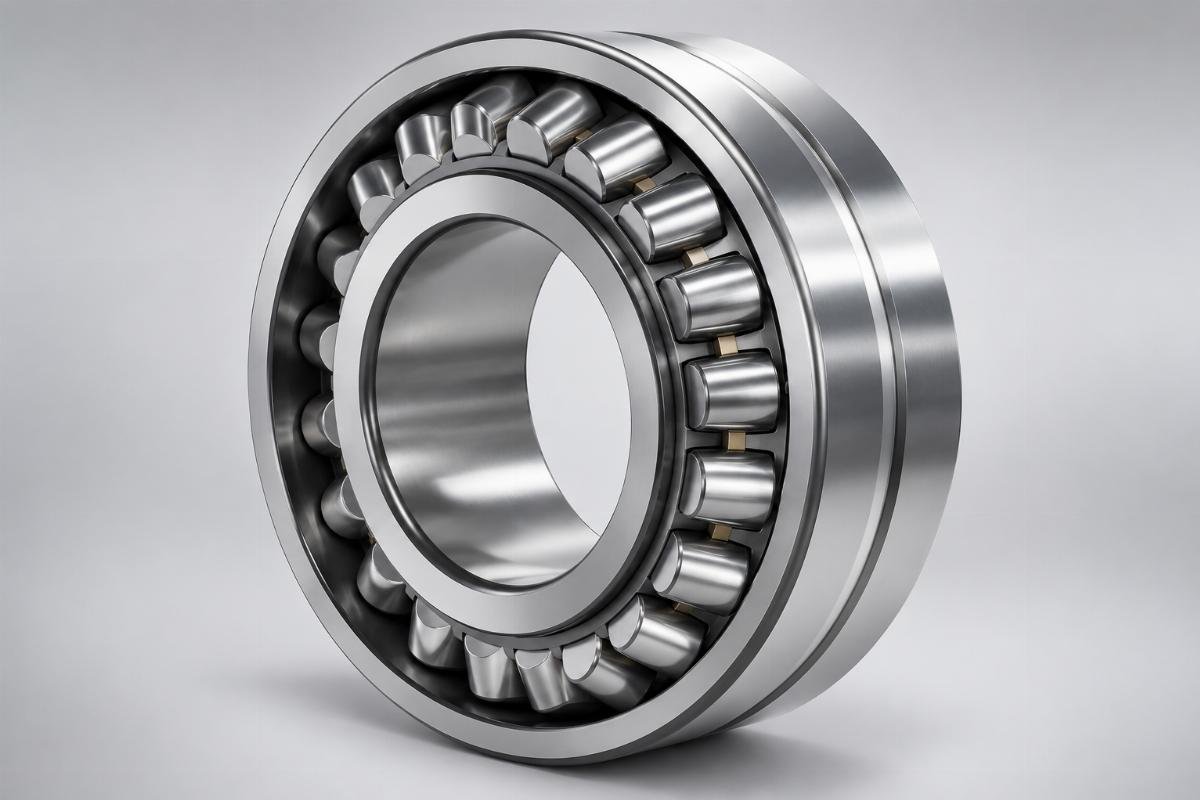
A copper mine in South America faced a mid-six-figure production loss after installing counterfeit bearings in their primary crusher. The fake bearings failed after only 45 days of operation, causing a critical production shutdown. We supplied genuine 241/800CAK30/W33 spherical roller bearings (800mm ID) with full IATF 16949 certification and anti-counterfeiting verification. These bearings featured enhanced dust resistance and shock load capability specifically engineered for mining applications, resulting in a service life of 18 months—four times longer than the counterfeit units [NEED_CITE: ISO 15243 failure analysis confirms contamination and counterfeit materials as primary failure modes in mining crushers].
The critical selection factors for roller bearings:
- Spherical Roller Bearings – Select for applications with misalignment or heavy shock loads
- Tapered Roller Bearings – Choose for gearboxes requiring both radial and axial load handling
- Cylindrical Roller Bearings – Implement in high-radial-load electric motor applications
- Needle Roller Bearings – Use in agricultural machinery components with limited installation space
- Thrust Roller Bearings – Specify for vertical shafts and pressing applications with high axial loads
When the ball vs roller bearings decision hinges on load magnitude and shock resistance, roller bearings are the only viable option. But verify authenticity—counterfeit roller bearings in heavy industry create catastrophic failure risks.
How Do You Avoid Bearing Selection Failures in Procurement?
A systematic five-step selection process combined with rigorous supplier verification eliminates the majority of bearing failures before they occur.
The selection methodology:
- Load Direction Analysis – Determine primary load type (radial, axial, or combined) using equipment torque specifications
- Speed Calculation – Measure operational RPM against bearing manufacturer speed ratings
- Environmental Assessment – Document temperature extremes, contamination risks, and moisture levels
- Precision Requirement – Identify necessary radial runout and axial clearance tolerances
- Service Life Expectation – Calculate required L10 life based on production uptime targets
The Brazilian steel mill case I mentioned earlier illustrates a critical procurement failure point: perfect certificates and perfect packaging don’t guarantee correct application. The buyer specified C3 clearance, but his continuous caster actually required different internal clearance for thermal expansion. The bearing wasn’t defective—it was misapplied.
To prevent selection failures, your China supplier must provide:
- Batch traceability – Every shipment traceable from manufacturing source to delivery
- Application engineering support – Load calculation, L10 life analysis, and failure investigation services
- Anti-counterfeiting verification – Batch numbers verifiable against manufacturer records
- Customization capability – Clearance, material, and precision grade modifications with reasonable lead times
- Quality certification – ISO 9001 and IATF 16949 compliance with material certification documentation
Our experience working with a US-based food processing equipment OEM illustrates the importance of supplier partnership. The client needed modified stainless steel cylindrical roller bearings with FDA-compliant lubrication for their new processing line. While other suppliers quoted several months lead times for custom bearings, our self-operated warehousing enabled delivery in just 4 weeks for their initial order.
What Supplier Criteria Matter Beyond the Bearing Itself?
Supplier selection is as critical as bearing type selection—even the optimal bearing choice fails without reliable supply, proper documentation, and technical support throughout the product lifecycle.
| Selection Factor | Critical Evaluation Criteria |
|---|---|
| Product Authenticity | Full traceability documentation from manufacturing source to delivery |
| Technical Support | Availability of application engineering, load calculation, and failure analysis services |
| Delivery Capability | Standard model dispatch within 48 hours, emergency shipment options |
| Customization Flexibility | Ability to modify clearance, materials, and precision grades with reasonable turnaround for small batches |
| Quality Certification | ISO 9001 and IATF 16949 compliance with material certification documentation |
As an authorized SKF bearing distributor headquartered in China, we maintain direct supply from SKF China and SKF global HQ with full batch traceability on every shipment. Our deep stock of rare designations—large bore, special precision/clearance, ceramic/stainless—ships in 48 hours versus typical factory lead times of several weeks.
For OEM factories requiring exact conformance and batch consistency, we provide per-batch precision inspection, laser marking, private-label packaging, and translated documentation. For project suppliers facing fixed delivery windows, we offer certificate of origin, DDP capability, and delivery certainty.
The ball vs roller bearings decision extends beyond technical specifications to supply chain reliability. A traceable China supplier with application engineering support prevents premature failure through correct selection and authentic product delivery.
Conclusion
Ball vs roller bearings selection must match load type, speed, precision, and environment—ball bearings excel in high-speed precision, roller bearings dominate heavy-load shock applications.
Correct pairing with a traceable China supplier prevents premature failure through systematic selection methodology, batch traceability, and application engineering support. The majority of bearing failures stem from incorrect type selection rather than manufacturing defects—verify your supplier provides authentic products with full documentation and technical expertise to match bearing technology to your specific operational requirements.
