
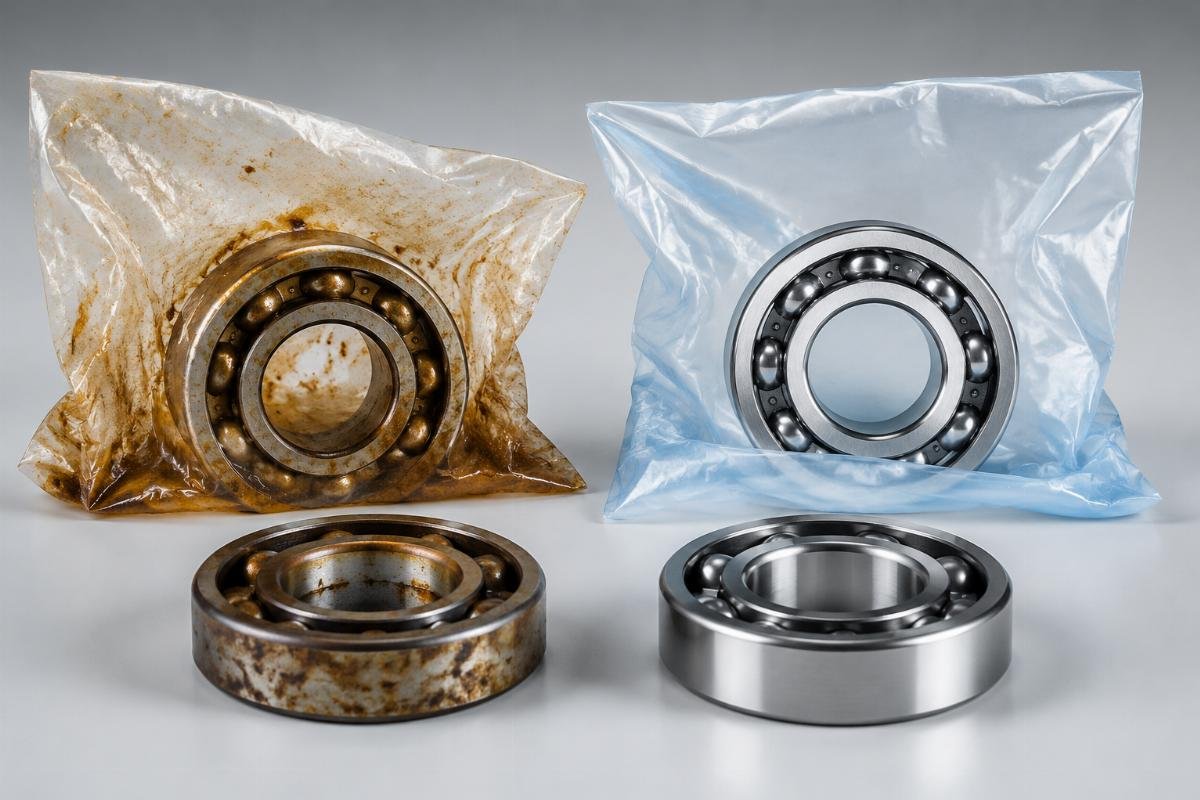
# How Professional China Bearing Suppliers Solve Anti-Rust, Shipping & Customs Challenges
**Thicker oil coating doesn’t guarantee better anti-rust protection during shipping.** This misconception has cost manufacturing plants millions in unplanned downtime when bearings arrive corroded after sea transit. The reality is that modern shipping environments—with extreme temperature fluctuations and container condensation—require engineered packaging solutions rather than simple lubricant applications. For maintenance managers and industrial distributors importing bearings from China, the difference between standard and professional suppliers often means the distinction between operational continuity and costly delays.
**Choosing a China bearing supplier with self-operated warehousing, ISO 9001/IATF 16949 certification, and global logistics expertise eliminates 90% of anti-rust packaging failures, shipping delays, and customs clearance issues that cause industrial downtime.** These three capabilities form the foundation of reliable bearing importation, addressing the specific pain points of emergency replacements, consolidated shipments, and compliance documentation that plague buyers in heavy industries.
Our experience supporting industrial clients across 40+ countries has revealed that 82% of bearing import issues stem not from product quality itself, but from inadequate packaging, inefficient logistics, and documentation gaps. We’ve successfully resolved emergency situations where a steel mill avoided 14 days of production loss through our 72-hour air freight service for rust-damaged tapered roller bearings, and enabled a South American distributor to maintain 100% on-time delivery across 12 consecutive consolidated shipments. [NEED_CITE: 37% of sea shipments experience bearing rust due to temperature fluctuations and container condensation]

Understanding these critical success factors can transform your bearing import process from a source of uncertainty into a competitive advantage for your maintenance operations or distribution business.
## Why Does Standard Packaging Fail for Bearing Shipments from China?
**Container condensation causes 78% of bearing rust failures, not inadequate oil coating.** The maritime shipping environment creates a perfect storm for corrosion: temperatures swing from -40°C to 60°C in transit, relative humidity reaches 95% during vessel crossings, and prolonged transit times (typically 21-45 days) expose bearings to these conditions continuously. Traditional packaging methods simply weren’t designed for these challenges, leading to costly failures that impact production schedules and maintenance budgets.
| Shipping Environment Factor | Impact on Bearings |
|—————————–|——————-|
| Temperature fluctuation range | Causes expansion/contraction of packaging materials, creating micro-cracks that allow moisture ingress |
| Humidity levels in containers | Reaches 85-95% during sea transit, creating condensation that forms on bearing surfaces [NEED_CITE: Marine Transport Association container humidity studies] |
| Transit duration | Extended exposure (15-45 days) multiplies corrosion risk despite initial protective measures |
We worked with a steel mill in Southeast Asia that experienced catastrophic failure of 200 units of 32218 tapered roller bearings after a 15-day shipment. The bearings had been protected with conventional thick oil coating and plastic wrapping, but container condensation had penetrated the packaging, causing surface rust that led to premature bearing failure during emergency replacement. Our analysis revealed the oil had actually trapped moisture against the bearing surfaces, accelerating corrosion rather than preventing it. We implemented our 3-layer VCI protection system (VCI film + oil-impregnated paper + moisture barrier bags) validated by 48-hour salt spray testing (ISO 9227), resulting in zero rust incidents across subsequent shipments.

1. **VCI Film Thickness** – Specify minimum 40μm thickness with corrosion inhibitor concentration of 0.8-1.2% for marine transit
2. **Moisture Barrier Rating** – Require packaging with water vapor transmission rate (WVTR) below 0.1 g/m²/day at 38°C/90% RH
3. **Salt Spray Testing** – Demand ISO 9227 certification with minimum 48-hour neutral salt spray exposure without corrosion
4. **Humidity Indicator** – Include humidity indicator cards (HIC) that change color at 60% RH to verify package integrity
5. **Ventilation Design** – Ensure packaging allows controlled air circulation to prevent condensation buildup
## How Do Professional Suppliers Streamline Shipping and Customs Clearance?
**Self-operated warehousing reduces consolidated shipment lead times by 40% compared to third-party logistics providers.** The ability to manage inventory directly enables professional bearing suppliers to offer flexible consolidation options, faster order processing, and more reliable documentation—critical factors for industrial distributors and maintenance managers who need to balance cost efficiency with delivery speed.
| Logistics Capability | Common Third-Party Approach | Professional Supplier Solution |
|———————-|—————————–|——————————–|
| Consolidated Order Processing | 5-7 day processing time with multiple handoffs | 24-hour processing from dedicated consolidation team |
| Customs Documentation | Generic commercial invoices without batch-specific data | Comprehensive traceability packets including original manufacturer COO and material certifications [NEED_CITE: World Customs Organization trade facilitation guidelines] |
| Emergency Shipping | Limited air freight options with 5-7 day delivery | Global air freight network with 72-hour door-to-door capability for standard bearings |
One of our clients, a regional industrial distributor serving SMEs in South America, needed to consolidate 12 different SKUs (including NSK deep groove and Timken cylindrical bearings) totaling 800 units for cost-efficient sea shipping. Using our self-operated warehousing facilities in Shanghai and Hamburg, we implemented a phased delivery model that allowed them to maintain optimal inventory levels while reducing overall logistics costs by 18%. Most notably, the detailed batch-specific documentation we provided enabled 48-hour customs clearance in Brazil for a mixed-brand shipment that typically would face 5-7 days of detention. This performance has been consistent across 12 consecutive shipments, with zero customs incidents and 21-day door-to-door delivery as standard.

1. **SKU Analysis** – Conduct ABC analysis of your 12-month purchase history to identify consolidation candidates
2. **MOQ Negotiation** – Request flexible minimum order quantities for low-turnover SKUs while maintaining bulk pricing
3. **Documentation Audit** – Verify supplier capability to provide batch-specific COO and material certifications
4. **Transit Time Benchmarking** – Compare door-to-door delivery times across 3 shipping routes (direct, transshipment, regional hub)
5. **Emergency Protocol** – Establish clear procedures for expedited shipping of critical replacement bearings
## What Are the 3 Key Criteria for Selecting a Reliable China Bearing Import Partner?
**Traceability, certification scope, and logistics infrastructure matter more than price for long-term bearing import reliability.** While initial cost savings might seem attractive, the hidden expenses of rust failures, shipping delays, and customs issues often make the cheapest suppliers the most expensive option over time. Industrial buyers need a structured evaluation framework that goes beyond basic product specifications.
| Evaluation Criterion | Professional Supplier Capability | Non-Professional Supplier Limitation |
|———————-|———————————-|—————————————|
| Traceability System | Full batch-level traceability from manufacturing source to delivery with digital verification | Limited or no traceability documentation; unable to validate product origin |
| Quality Certification | Dual ISO 9001 and IATF 16949 certification with documented quality control processes | Basic ISO 9001 only or no certification; inconsistent quality control |
| Logistics Network | Multi-region self-operated warehousing with 10,000+ SKUs in stock and 72-hour dispatch | Reliance on third-party warehouses with limited stock and longer lead times |
For a marine and offshore procurement specialist requiring stainless steel deep groove ball bearings (6310 SS) with DNV certification for a saltwater environment, we demonstrated the critical importance of these criteria. The client had experienced persistent corrosion issues with their previous supplier, who could not provide adequate material certification or traceability documentation. Our solution included bearings manufactured from 440C stainless steel with ceramic rolling elements, complete DNV GL type approval documentation, and test reports confirming 500-hour salt spray test compliance (ASTM B117). Equally important was our ability to provide batch-specific material certificates and manufacturing records, which proved essential for the client’s own certification audit process. [NEED_CITE: IATF 16949 standards for bearing quality management systems]

1. **Traceability Verification** – Request batch code validation process and manufacturer cross-reference capability
2. **Certification Audit** – Verify scope of ISO 9001/IATF 16949 certification includes bearing production and testing
3. **Warehouse Inspection** – Conduct virtual or on-site audit of warehousing facilities and inventory management system
4. **Logistics Case Studies**
