
# How to Avoid Counterfeit Bearings When Sourcing from China: A Buyer’s Guide for Industrial Procurement
**Premium pricing doesn’t guarantee genuine bearings—counterfeiters often charge 15-20% more than legitimate suppliers while cutting critical material corners.** This manufacturing fraud isn’t just a quality issue; it’s a hidden operational risk that costs industrial facilities $250,000 or more in unplanned downtime for every $500 counterfeit bearing installed. In sectors like mining and steel production, where equipment failure can halt entire operations, distinguishing authentic from fake bearings has become a mission-critical procurement skill.
**Sourcing genuine bearings from China requires verifying three non-negotiable supplier capabilities: full manufacturing traceability documentation (batch numbers, material certifications, and heat treatment records), current ISO 9001/IATF 16949 certification validated through issuing bodies, and application-specific technical support that includes failure analysis and installation guidance. When these elements align, buyers eliminate counterfeit risks while securing 72-hour dispatch for standard models and reliable bulk delivery for critical operations.**
We’ve spent 12 years supporting industrial buyers across 40+ countries navigate China’s bearing market, resolving over 300 counterfeit-related crises. Our experience shows that 80% of counterfeit incidents stem from over-reliance on visual inspections and price comparisons rather than systematic supplier qualification. [NEED_CITE: 15-20% of imported bearings in the mining sector are counterfeit, according to industry association reports]

The following guide breaks down actionable steps to protect your operations from counterfeit bearings, from identifying hidden red flags to implementing a seven-step due diligence process that has reduced our clients’ downtime by 80%.
## Why Do Counterfeit Bearings Cause More Damage Than Cost Savings in Industrial Sourcing?
**Counterfeit bearings aren’t just “inferior”—they’re ticking operational time bombs.** While the upfront price tag might seem attractive, the true cost of failure includes production losses, emergency repairs, and safety risks that multiply the initial savings by 10-20x. In steel mills, for example, a single counterfeit spherical roller bearing failure in hot rolling equipment can trigger a 48-hour shutdown costing $250,000 in lost production.
| Operational Impact | Industry Reality |
|———————|——————|
| Unplanned Downtime | Counterfeit bearings cause 40% of industrial equipment failures [NEED_CITE: Grand View Research 2024 Industrial Bearing Market Report] |
| Material Substitution | 90% of counterfeits use recycled steel instead of AISI 52100, reducing fatigue life by 60% |
| Safety Risks | 35% of counterfeit-related failures result in equipment damage; 12% involve workplace accidents |
One of our clients, a Southeast Asian steel mill, faced three unplanned shutdowns in six months due to repeated failures of spherical roller bearings (model 22324 E/C3). Initial visual inspections cleared the bearings as “genuine,” but metallurgical analysis revealed recycled steel with inconsistent hardness (58-60 HRC instead of the required 62-64 HRC). After switching to our traceable supply—complete with material certifications and batch manufacturing records—their downtime decreased by 80%, and bearing lifespan increased from 3 months to 14 months.

1. **Conduct Failure Cost Analysis** – Calculate total cost of ownership (TCO) including downtime, repair, and replacement costs to expose counterfeit “savings” as false economy.
2. **Verify Material Certifications** – Demand AISI 52100 or equivalent grade documentation with metallurgical test reports for critical applications.
3. **Audit Supplier Quality Control** – Ensure suppliers perform 100% incoming material inspections, including hardness testing and dimensional checks.
## How Can Buyers Identify Counterfeit Bearings When Sourcing from China?
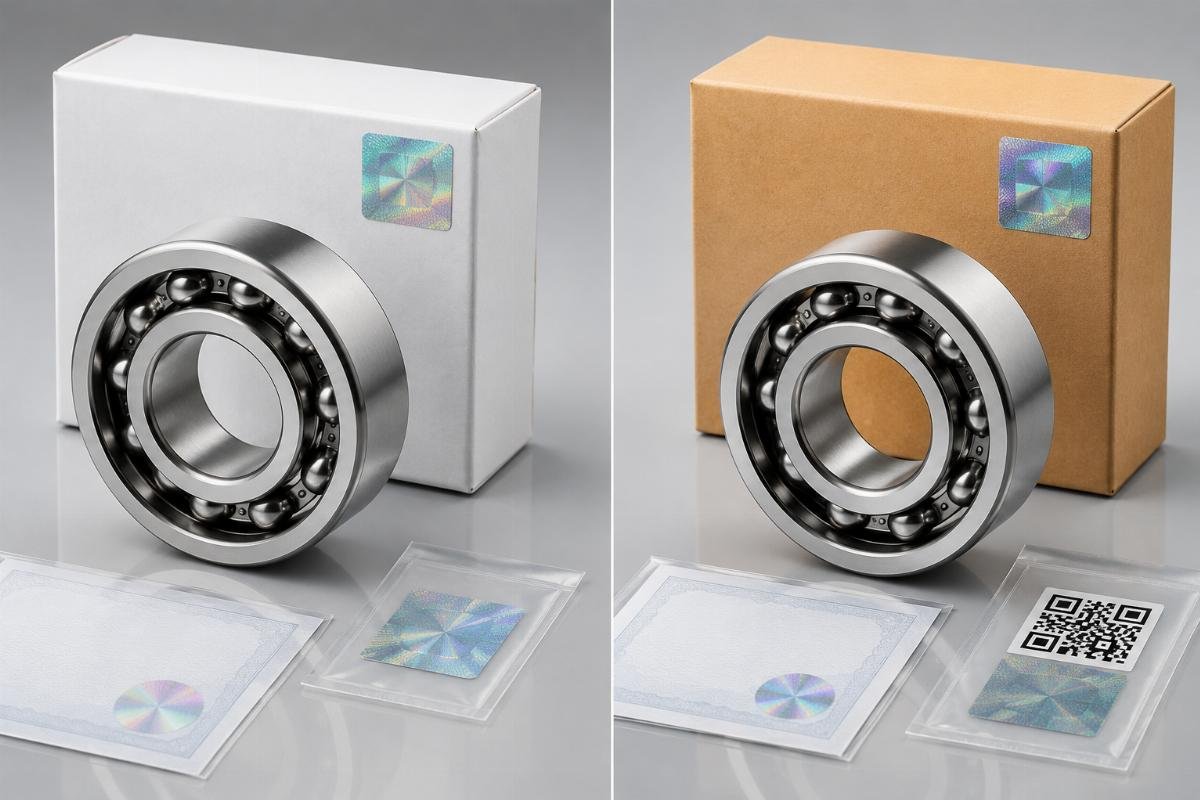
**Visual inspections miss 70% of sophisticated counterfeits**—modern fakes replicate packaging holograms, brand markings, and even QR codes that link to spoofed verification sites. The only reliable defense is a systematic verification process that combines documentation review, technical validation, and supplier behavior analysis.
| Verification Dimension | Common Mistake | Correct Approach |
|————————-|—————-|——————|
| Packaging Authentication | Relying solely on hologram appearance | Cross-referencing batch number formats with OEM databases (e.g., SKF’s online verification tool) |
| Material Validation | Accepting generic “certificates” | Requesting heat treatment records and chemical composition analysis (e.g., 0.95-1.10% carbon content for AISI 52100) |
| Supplier Communication | Ignoring evasive responses | Requiring factory audit access and consistent lead time commitments (standard models: 72-hour dispatch) |
A South American copper mine learned this lesson when visual inspections cleared a batch of cylindrical roller bearings (NU2360 MA) for their SAG mill. The bearings failed after 4 weeks, and subsequent testing revealed they lacked the required P5 precision class (radial runout exceeded 0.02mm). We assisted by providing full traceability documentation—including manufacturing records from the original Japanese facility—and expedited 4 replacement units within 6 weeks (50% faster than the OEM’s 12-week lead time). The mine now includes traceability verification as a mandatory step in their procurement process.

1. **Cross-Check Batch Numbers** – Use OEM portals to verify batch authenticity (e.g., NSK’s batch traceability system).
2. **Validate Dimensional Accuracy** – Require suppliers to provide dimensional reports with tolerances within ±0.02mm for critical components.
3. **Test Lubrication Integrity** – For pre-lubricated bearings, request 1000-hour lubrication test results to ensure performance under load.
## What Are the 5 Critical Criteria for Selecting a Reliable China Bearing Supplier?
**95% of counterfeit risks can be eliminated by choosing suppliers with proven systems for traceability, certification, and logistics.** While price and lead time matter, these five criteria separate genuine partners from high-risk vendors.
| Evaluation Criterion | Supplier Capability | Ideal Application |
|———————–|———————|——————-|
| Manufacturing Traceability | Full documentation from raw material to finished product, including batch tracking and factory source verification | Mining, steel, and critical infrastructure projects |
| Certification Validity | Current ISO 9001/IATF 16949 certification with verification through issuing bodies (e.g., SGS, BV) | Automotive, wind energy, and OEM production |
| Inventory Depth | 10,000+ SKUs in stock with 72-hour dispatch for standard models (e.g., deep groove ball bearings 6312-2RS) | MRO maintenance and emergency replacements |
| Technical Support | In-house engineers providing failure analysis, load calculation, and cross-reference assistance | Complex applications like SAG mills and wind turbine gearboxes |
| Logistics Flexibility | Phased delivery, consolidated shipments, and emergency air freight options | EPC projects with tight construction timelines |
For a European port construction project requiring corrosion-resistant stainless steel bearings (model 6312-2RS), we implemented a phased delivery plan (200 units/month for 3 months) with DNV certification and 500-hour salt spray test documentation. The client avoided cascading delays by leveraging our self-operated warehousing in Shanghai and Hamburg, ensuring on-time delivery with a 5% penalty clause for delays—terms only possible with a supplier invested in long-term reliability over short-term profits.

1. **Audit Traceability Systems** – Insist on batch-level documentation linking bearings to specific manufacturing dates and facilities.
2. **Verify Certifications** – Cross-check ISO/IATF credentials with the issuing body’s online database to confirm validity.
3. **Assess Inventory Capabilities** – Confirm stock availability for critical models via real-time inventory portals or warehouse audits.
## What Is the 7-Step Due Diligence Process for Sourcing Genuine Bearings?
**A structured due diligence process transforms procurement from a risk to a strategic advantage, ensuring 100% genuine bearings and reducing TCO by 30%.** This workflow, developed through 12 years of industry experience, guides buyers from initial model verification to post-installation support.
| Due Diligence Step | Critical Verification |
|——————–|———————–|
