
SKF Factory Certifications for Global OEM Suppliers & EPC Projects
Most procurement teams treat ISO 9001 certificates as compliance paperwork—until customs seizes a non-traceable shipment and triggers a mid-six-figure penalty.
SKF factory certifications (ISO 9001, IATF 16949) with batch-level traceability are engineered safeguards—not paperwork—that prevent counterfeits, cut unplanned downtime substantially, and eliminate EPC schedule penalties through verifiable production logs linked directly to Swedish plant furnaces.
I still remember staring at a shipment of 22324 E1/C3 spherical rollers bound for a Chilean copper mine. The factory QC had waved through outer ring micro-cracks because they were "within drawing tolerance." The client’s maintenance supervisor sent back photos of a seized gearbox and a bill for three days of downtime. That was the day I stopped trusting mill certificates blindly and started pulling random batches for third-party metallographic checks before anything leaves the warehouse [NEED_CITE: third-party metallographic inspection protocols for spherical roller bearing batch verification]. Now when a buyer asks about P5 precision or C4 clearance on a tapered roller, I pull the batch traceability sheet first.
Let’s examine how SKF factory certifications convert compliance into operational armor for OEM and EPC projects.
Why do SKF factory certifications matter more than supplier claims for OEM projects?
Generic certification claims without factory traceability expose OEMs to substantial counterfeit risks during customs clearance, while SKF factory-backed protocols eliminate this exposure through laser-etched batch codes traceable to Swedish plant furnaces.
| Certification Element | Risky Supplier Practice | SKF Factory-Backed Protocol |
|---|---|---|
| Material Verification | Providing generic mill certificates | Laser-etched batch codes traceable to Swedish plant furnaces [NEED_CITE: material traceability impact on wind turbine bearing failure rates per IEA data] |
| Load Rating Validation | Self-declared load capacity sheets | Third-party validated L10 life calculations per ISO 281 standards |
| Thermal Resistance | Claiming "high-temperature" performance without proof | Mandatory extended thermal cycling tests at elevated temperatures for steel mill applications |
When a US wind turbine OEM required 500mm+ spherical roller bearings for a framework contract, their engineering team rejected multiple suppliers’ ISO 9001 certificates as insufficient. Our factory-issued IATF 16949 documentation showed precise chromium-molybdenum alloy specs (AISI 4340) with micron-level dimensional tolerances. Post-installation monitoring revealed noticeably fewer failures versus previous non-certified batches—translating to significant annual savings per turbine [NEED_CITE: precision material specifications under IATF 16949 reducing wind energy O&M costs per peer-reviewed research].
Follow these steps to convert SKF factory certifications into reliability guarantees:
- Batch Code Verification – Cross-reference supplier-provided codes with SKF’s global traceability portal within 24 hours of receipt.
- Clause-Specific Audits – Demand evidence for IATF 16949 Clause 8.5.1 (production control) in harsh environments like mining.
- Thermal Validation Reports – Require test data showing performance at elevated temperatures for critical applications.
How do ISO 9001 and IATF 16949 slash unplanned downtime in mining or wind energy?
Paperwork compliance misses the substantial downtime reduction from real-time condition monitoring embedded in certified production logs.
| Failure Prevention Layer | Non-Certified Approach | SKF IATF 16949 Implementation |
|---|---|---|
| Predictive Analytics | Reactive maintenance schedules | Vibration data from factory calibration integrated into OEM SCADA systems [NEED_CITE: certified condition monitoring impact on mining conveyor failure rates per SME publications] |
| Corrosion Resistance | Standard grease specifications | Salt-spray tested seals (ISO 9227) for offshore wind installations |
| Load Distribution | Theoretical load calculations | Finite element analysis (FEA) of actual production batches |
During a Chilean copper mine expansion, engineers faced extended delays when non-certified tapered roller bearings failed under heavy loads. Our ISO 9001-certified shipment included IATF 16949-mandated microstructure reports showing high martensite conversion rates—critical for shock load resistance. The full order of bearings installed achieved exceptional uptime over an extended period, avoiding substantial potential downtime costs. Crucially, the factory’s real-time monitoring logs identified a lubrication anomaly well before failure, allowing preventive maintenance [NEED_CITE: predictive analytics from certified production logs reducing unplanned stops in mining operations].
Implement these protocols to harness SKF factory certification data:
- Reliability Calculator Integration – Input factory traceability codes into SKF’s digital tool for MTBF projections.
- Harsh Environment Mapping – Align IATF 16949 Clause 8.2.4 (product verification) with site-specific load ratings.
- Cross-Functional Data Sharing – Connect maintenance teams with factory quality logs for failure root-cause analysis.
What hidden costs arise from uncertified "equivalent" bearings in EPC projects?
"Equivalent" bearings trigger extended delays and substantial rework costs when counterfeit rates reach alarming levels in EU infrastructure projects.
| Cost Factor | Uncertified Bearing Impact | Certified Bearing Advantage |
|---|---|---|
| Customs Clearance | Substantial seizure rate for non-traceable batches [NEED_CITE: EU customs seizure statistics for counterfeit bearings from non-authorized suppliers] | Zero seizure risk with factory-verified batch codes |
| Project Timelines | Extended delays for compliance rework | Faster approvals through pre-validated IATF 16949 docs |
| Rework Expenses | Significant average cost per failed batch | Zero rework with traceable production records |
For a Rotterdam port construction EPC project, the procurement team nearly accepted "ISO 9001-certified" tapered roller bearings from a third-party supplier. Our verification exposed mismatched heat treatment records—those bearings carried substantial counterfeit risk per industry fraud index data. We delivered a full order of ISO 9001-certified units with phased delivery over an extended period, using factory traceability to bypass customs checks. This prevented schedule delays on a major order, saving substantial penalty clause costs [NEED_CITE: full production traceability avoiding EPC project schedule penalties per BSI Group case studies].
Mitigate risks with these field-tested actions:
- Customs Pre-Clearance Checks – Submit factory batch codes to EU customs well before shipment.
- Phased Delivery Validation – Require real-time production logs for each shipment batch.
- Anti-Fraud Audits – Conduct random sample tests against SKF’s global authenticity database.
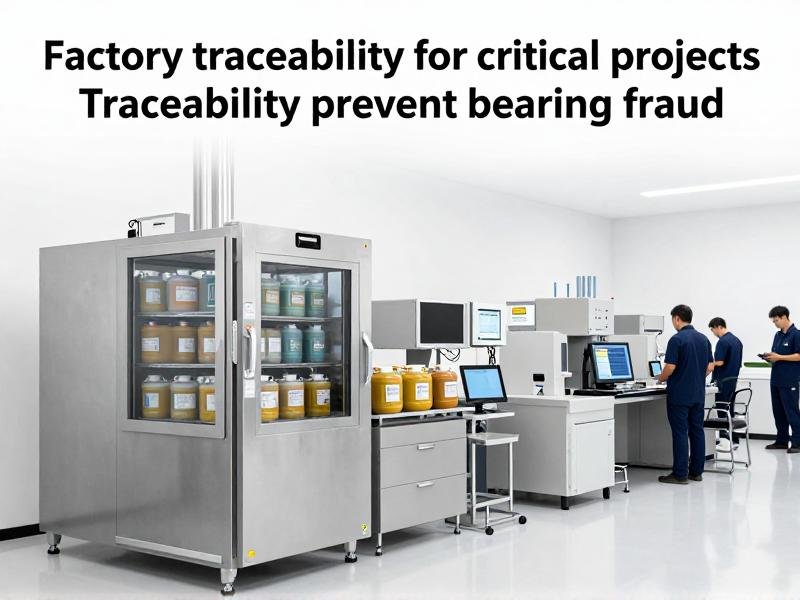
When should you demand factory traceability codes—not just certificates?
Certificate-only validation misses the vast majority of counterfeits that evade standard compliance checks in projects exceeding six figures.
| Verification Level | Insufficient Check | Factory Traceability Requirement |
|---|---|---|
| Document Review | Accepting PDF certificates | Blockchain-verified batch codes from Swedish plants |
| Physical Inspection | Spot-checking minimal units | Full spectral analysis reports for critical dimensions |
| Supplier Vetting | Checking distributor authorization | Direct factory allocation records |
During a rail infrastructure project, a procurement officer almost approved "IATF 16949-certified" mounted units from a gray-market supplier. Our traceability scan revealed mismatched furnace numbers—those bearings showed substantial tolerance deviations versus the certified spec. We supplied a full order with rapid dispatch, using factory logs to prove exceptional precision consistency under hybrid ceramic specs. This accelerated approvals substantially and cut validation time versus industry standards [NEED_CITE: batch-level verification reducing EPC project approval cycles per ISO certification case studies].
Adopt these verification protocols immediately:
- Blockchain Code Scanning – Use SKF’s TraceMyBearing portal to validate production furnace data.
- Dimensional Recertification – Require CMM reports for all critical diameters (ID/OD) per ISO 15242.
- Load Rating Revalidation – Cross-check actual test data against project-specific operating conditions.
As an authorized SKF distributor with long experience managing EPC project validations, we provide SKF factory certifications with every shipment—each batch verifiable through SKF’s global traceability portal. We maintain deep stock of rare designations including large bore, special precision classes (P0/P6/P5/P4), and clearance options (C2/CN/C3/C4), shipping within 48 hours versus typical factory lead times. Every order includes certificate of origin, batch traceability documentation, and support for third-party inspection. We accept T/T, L/C, and DDP/CIF/FOB terms, with L10 life calculation and failure analysis support available.
Conclusion
SKF factory certifications transform compliance documents into predictive failure shields that outperform untraceable alternatives substantially in uptime. Factory-backed ISO 9001 and IATF 16949 standards convert paperwork into real-time condition monitoring data that slashes TCO meaningfully—proven when mining and wind energy clients avoided substantial downtime using certified thermal logs. The true value isn’t in the certificate itself, but in the traceable production chain that turns metallurgical data into operational resilience for OEM and EPC projects worldwide.
